
Health

13 Cool Facts About Water which No One Tells You

Drink water?Why?How will water benefit you?Why should you drink water?How much water is enough?How to drink more water?13 Cool facts about water which no one tells you is the one post you must bookmark to remember why you need to drink more water.
What I must tell you at the beginning:
Water is a miracle fluid.Oxygen and water are essentials for life.If you think drinking tea, coffee, juices will take care of your water needs, stop kidding yourself.
About water, a lot of varied information will fly.I want to help you know the truth from the myths!
Content breakdown:
- 13 Cool Facts About Water which No One Tells You
- What are the factors which will determine your water needs
- How do you know you are drinking enough water?
- How to drink more water?
- How to make your child drink more water?
- Listen to the podcast
- Watch the video
13 Cool Facts About Water which No One Tells You
1)Drink 500 ml water half an hour before each meal.This will not only help you meet daily water goals but also help you lose excess weight.
2)Suffering from acidity and GERD?Drinking water helps in this too.
3)Water when replacing sugar-laden calorie-heavy drinks help you cut down on extra calories.With obesity a rising epidemic, you can’t afford to ignore this.
4)Physical activity and cognitive function are both improved with good hydration.Important especially in athletes and children to drink adequate water on a daily basis.
5)Older people . may experience delirium and dementia with dehydration.Since their thirst sensation is often altered It’s important for the elderly to drink adequate water.
6)The most obvious effect is on your gut health.If you don’t visit the loo regularly for your morning calls its something you need to think about.Constipation is not cool.A healthy bowel makes a healthy person.
7)Your kidney is crucial in managing your body’s water balance and blood pressure..Your kidney also needs water to filter the toxins from your blood which gets excreted in urine.
No water and this filtration system get strained and urine is decreased and is high-colored.
8)Drink water to prevent a headache and be happy.
Mood swings, irritability, and headache triggers are common signs of low water intake.Lack of adequate water may act as a trigger for migraines.
9)Water intake helps to increase concentration and cognition in children.
10)Adequate water intake reduces urinary tract infection.
11)Water intake has a strong preventive action against kidney and urinary stone formation.
12)It also reduces hypertension, fatal coronary heart diseases, venous thromboembolism.It keeps your cardiovascular system healthy.
13)Water has an effect on your gut health .If you don’t visit the loo regularly for your morning calls, its something you need to think about.Constipation is not cool.A healthy bowel makes a healthy person.This evidence needs more corroboration though.But I think you already know the truth about this.
What are the factors which will determine your water needs
Your general health status .how healthy you are.During fevers, disease states, water need may be increased.
- Environment
- In the hot climate you will need more water to meet your hydration needs.
- Exercise: High BMR states and increase in physical activity means you sweat more and your body needs more water.
- Pregnancy or breastfeeding status .Both these physiologic states need good hydration
Water has a lot of actions other than just hydration.Its range of goodness makes it the right thing to add to your new year health goals.
How do you know you are drinking enough water?
- You will not be thirsty
- You will have great energy.
- Your urine will be light colored.
- You will be making all your cells happy.
How to drink more water?
- Carry your own cool water bottle.Have fruit infusion water.Not fruit juice, or drinks.
- Eat plenty of fruits and veggies.They contain a lot of water and can help fulfill your water needs along with nutrition needs.
How to make your child drink more water?
- Drink water with them.The best way to teach them is by setting an example.
- Make drinking water fun using a sipper or a straw.
- Include plenty of fruits and veggies in their diet.
- Have a water drinking challenge every day, with the loser having to do whatever the winner says.
Listen to the podcast summarizing the main points.
Written as a part of #ChatterPrompts’
13 Cool Facts About Water which No One Tells YouReferences:
NOSEBLEED in Kids: 3 THINGS YOU NEED TO KNOW(+A home care checklist download)

Nosebleed in children are worrying.Causes may be many and management of pediatric nose bleeds can be tricky .Read about nose bleed in adults here .
As a parent, it’s heartbreaking and you feel terribly upset.
It’s actually very common.
And not as worrying as it looks.
As an ENT surgeon nosebleed are some of the most frequent emergencies we attend.
The most important advice in cases involving children is rarely medicine.
I felt a little info about first aid home care for nosebleed would be useful.
Why does it happen?
Most often it’s due to nose picking.
Nose picking is easily the most common reason for nosebleed in children.
Luckily nosebleed in children are hardly ever life threatening.
But just knowing the why is not good enough .
Parents need to be aware of danger signs.
The signs below show when you need to visit the emergency.
#IMPORTANT TIP 1
THE DANGER SIGNS WHICH YOU SHOULD KNOW
- Massive nosebleed which cause difficulty breathing
- Massive nosebleed , which doesn’t stop even after the home-care described below.
- You find nosebleed has made your child pale, tired or disoriented.
- Nosebleed occur repeatedly, often and in very large amount without any trauma
- Child has undergone a recent nasal surgery
- Child has some tumour in the nose
Doctors will focus more on the child’s breathing and hemodynamic stability ,than the nosebleed.
This means the child might need intravenous fluid support, blood transfusion, moist oxygen inhalation
Identification of the site and cause of nosebleed, is of importance only after making the child stable.
WHAT CAUSES NOSEBLEED
IN CHILDREN:
- Blowing the nose very hard
- Injury to your child’s nose during playing
- Broken bones
- Temperature and humidity changes make the inside of your child’s nose become dry.
- Juvenile nasopharyngeal angiofibroma
WHAT COULD BE THE CAUSE OF FREQUENT NOSEBLEED IN CHILDREN?
Mostly systemic causes
- Bleeding disorders,coagulopathies:Haemophilia A, B, Factor IX deficiency(Von Willebrand disease)
- Leukemia
- Hereditary Haemorrhagic telangiectasia(HHT)
A study had found at least 1 episode of nosebleed occur
- In 30% children less than 5 years
- 56% children aged 6 to 10 year
- Children younger than two years rarely have nosebleed.
Child abuse is another worrying cause of recurrent nosebleed in children.
That’s a potential red flag for healthcare providers.
50% Adults with nose bleeding has the history of nosebleed during childhood.
#IMPORTANT THING NO.2
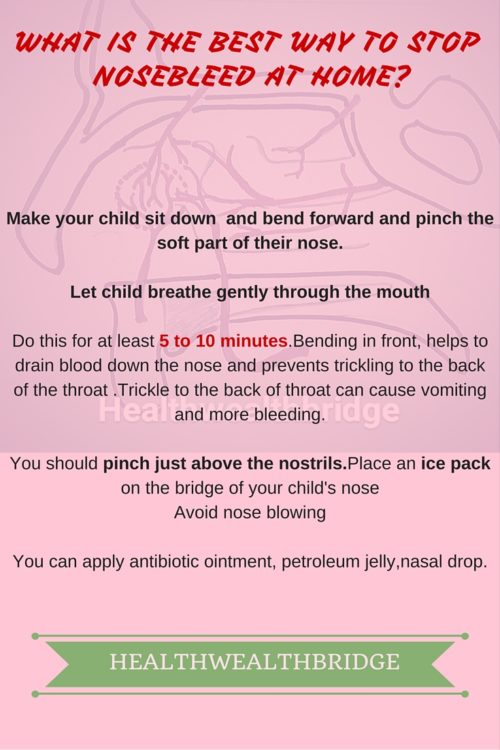
WHAT IS THE BEST WAY TO STOP A NOSEBLEED AT HOME?
How to stop Nose bleed
Make your child sit down and bend forward and pinch the soft part of their nose.
- Make your child breathe gently through the mouth
- Do this for at least 5 minutes.Most nosebleed stop by a maximum of 10 minutes of pinching the nose this way
- Bending in front, helps to drain blood down the nose and prevents trickling to the back of the throat .Trickle to the back of throat can cause vomiting and more bleeding.
- You should pinch just above the nostrils
- Place an ice pack on the bridge of your child’s nose
- Avoid nose blowing
- You can apply antibiotic ointment, petroleum jelly,nasal drop.
ANTERIOR EPISTAXIS
Nosebleed in children most commonly occurs from the front part of the nose.
This is known as anterior epistaxis.If its not controlled at home you might need to visit, the emergency of your nearest hospital.

WHAT OTHER WAYS WILL THE DOCTOR STOP THE NASAL BLEEDING
CAUTERY
- Chemical cautery – silver nitrate, TCA
- Electric cautery
- Laser photocoagulation
- Indication – if bleeding site is identified by noting
- Active bleeding
- An eschar
- Prominent vessel
CHEMICAL CAUTERY
- Agent – silver nitrate commonly used
Anaesthesia – LA
- 4% lidocaine within adrenaline or 4% lidocaine with 0.5 phenylephrine or by 10% cocaine
TECHNIQUE
- Circumferentially around the bleeding site and then the real offending bleeding vessel
Disadvantage –
- Repeated cauterization required
- Ulceration or septal perforation
ELECTRIC CAUTERY
- Indication active arterial bleed not controlled by silver nitrate
- Bipolar cautery preferred over unipolar cautery
- If aggressively performed a hole may be formed in the septum
- For posterior bleeding , it has to be stopped using a 30° endoscope and cautery
- In children – cautery should be used under GA.
CARE AFTER CAUTERY
- Local antibiotic ointment x 10 days
- Avoid nose blowing/ picking
- To keep the mouth open while sneezing
ANTERIOR PACKING
INDICATION
- If cautery is not possible
- If obvious site can not be identified
- If bleeding not controlled by cautery.
- Mechanism
- Adequate pressure to the bleeding site
- Thrombosis of bleeding
- Anaesthesia LA/GA
MATERIAL USED
- Absorbable substance
- Oxidized cellulose
- Gelatin sponge
- Surgicel
INDICATION
- In bleeding disorders
- Hereditary telangiectasia
Mechanism of action:All the absorbable packs help the blood to clot .They give a matrix for the platelets and fibrin particles interlinks. This way the bleeding from the nasal cavity can be stopped
ADVANTAGE
- Dissolves spontaneously
- Trauma of pack removal eliminated
MEROCEL PACK: This is in between an Absorbable nasal pack and ribbon gauze.This is made of biocompatible , polyvinyl alcohol sponge material which helps to stop bleeding .It has a very high-capacity for absorption .
Provides a mild pressure and tamponade effect after insertion in the nasal cavity .This tamponade effect helps to stop the bleeding.
It may be kept for upto 5 days , but under antibiotic cover.
Advantage:
- Highly hydrophilic and can absorb blood upto 21 times its volume
- Soft , compressible, easy to insert
- Very little trauma during insertion and removal
- Easy to cut and shape according to size of nasal cavity
Disadvantage:
It’s expensive.
Nasal bleeding which needs high tamponade effect to stop , may not be controlled
RIBBON GAUGE PACK
- Impregnated with antibiotic and vaseline.
– Layered placement of the pack filling

COMPLICATION OF ANP
DURING PACKING
- Vasovagal attack
- Blind packing aggravates bleeding ,as the friable mucosa is traumatized.
- Pushed into throat
WHILE PACK IS PREVENTION IN THE NASAL CAVITY
- Epiphora, or watering of eye
- Secondary sinusitis.Infection of the sinuses.
- Anosmia, sleep apnea
- Toxic shock syndrome
DURING REMOVAL OF PACK
- Vasovagal attack
- Further bleeding
Posterior nosebleeds:
Originate toward the back of the nasal passage, near the throat.Occurs mostly in elderly as hypertensive epistaxis.
Posterior nosebleeds are less common than an anterior nosebleed. But they can be serious and can cause a lot of blood loss. Children do not usually get posterior nosebleeds.
But if it does occur, they can be serious .Posterior epistaxis can cause significant blood loss and collapse.
In children it can occur following trauma to nose.
This causes the nasal bone to break and injury to the sphenopalatine artery .This sphenopalatine artery at the back of the nose can cause profuse bleeding.Thus is a serious emergency and needs urgent medical intervention.
HOW CAN FREQUENT NOSEBLEED IN CHILDREN BE MANAGED?
Consultation with your doctor is important in case of frequent nosebleed.
Careful history: Generally there is the history of prolonged bleeding after minor trauma, teeth extraction etc.
The child may be having other signs of frequent bleeding:
- Pinpoint bleeding spots under the skin (purpura)
- Repeated bruising
- Swollen painful joints
- Bleeding from other places, blood in urine, blood in stool
Investigation:
- Complete haemogram
- BT, CT, platelet count
- Prothrombin time/Activated Partial Thrombosis tin Time
- Hess’s test, factor VIII and IX assay
Treatment:
- Treat the cause
- Stop bleeding
- Cautery is contraindicated
#IMPORTANT THING NO.3
NOSEBLEED PREVENTION
If your child gets nosebleeds frequently.After a full checkup if you find its due to nasal crusts and nosepicking.
There are a few things which you can do to help stop nasal crusting.
The less the crust, less will be the childs tendency to pick his/her nose.
Te following measures will help reduce drying and crusting.This in turn will significantly decrease the nose picking and the chances of getting a nosebleed:
- Use a humidifier in your bedroom while sleeping, especially when the air is very dry.
- Keep your child’s nose moist using a saline nasal spray.
- Teach your child to stop picking his/her nose, clip their fingernails to avoid injury.
- Explaining to your child about the possibility of a doctors visit ,with nose bleed may help them not to pick their nose.
I hope you found this post helpful.
Please share and help another parent.They will thank you for this.
Featured post
How is the Health of the Nation: The report is an eye-opener!